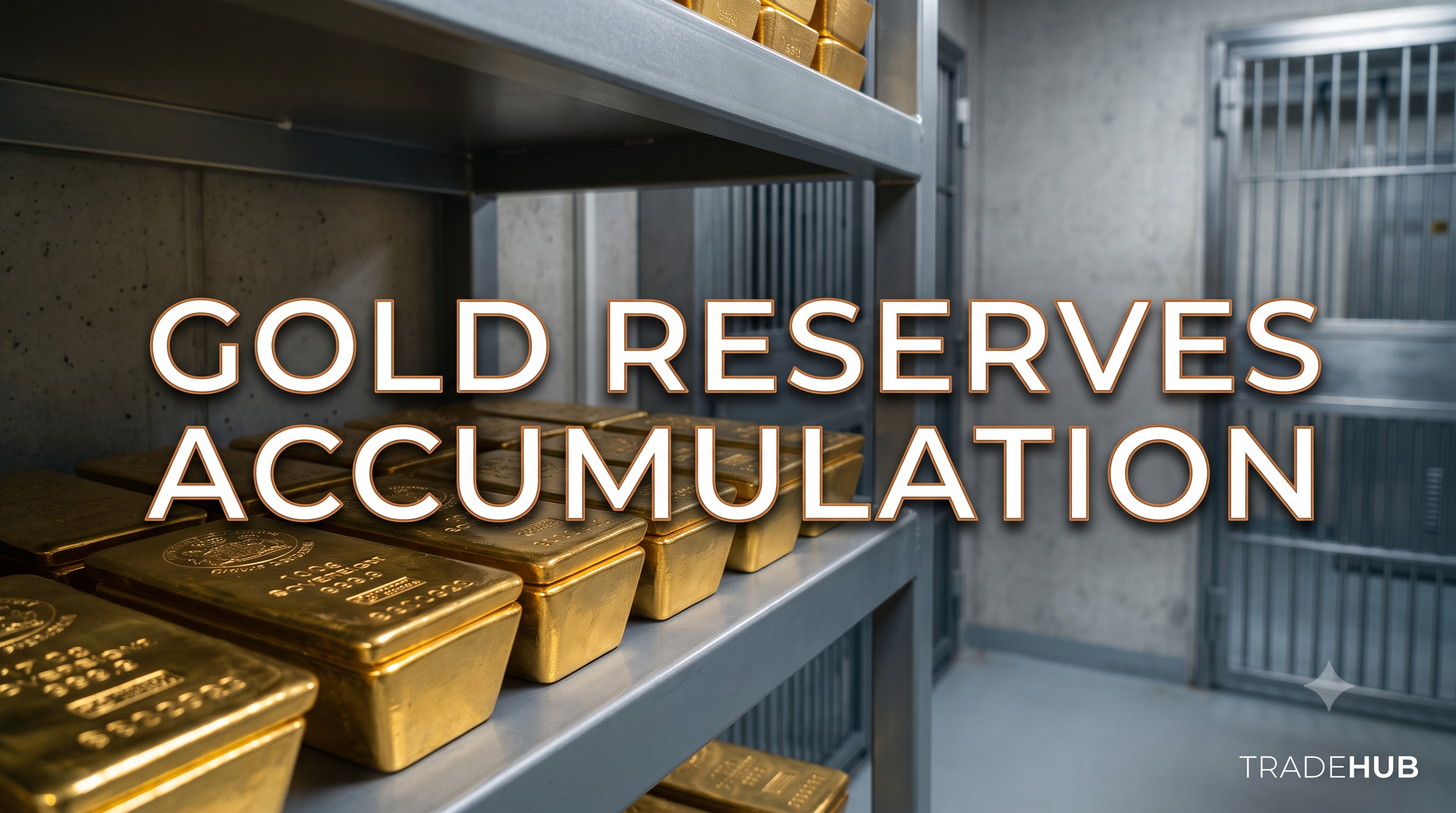
The New Order of FX Reserves: Why Global Institutions Continue to Accumulate Physical Gold
The dynamics of global financial markets are currently witnessing a tectonic shift rarely seen in recent decades. Behind the scenes of daily equity and bond market volatility, giant financial institutions and global central banks are aggressively hedging through one timeless asset: physical gold. This maneuver is not merely a tactical response to short-term price fluctuations, but a structural capital rotation indicating deep concerns regarding the sustainability of the purchasing power of major fiat currencies amidst macroeconomic uncertainty.
The Silent Maneuvers of Central Banks Amidst Uncertainty
Historical data from global commodity watchdogs indicates that the volume of precious metal purchases by monetary authorities has reached record levels of persistent accumulation. This phenomenon is driven by a crucial need to diversify foreign exchange reserves beyond traditional debt-based instruments. As geopolitical polarization intensifies sharply and global supply chains continue to face disruptions, reliance on a unipolar clearing system is being seriously re-evaluated, triggering a massive asset relocation from paper instruments to tangible assets.
Deciphering the Correlation Between Structural Inflation and Safe Haven Assets
For institutional portfolio managers, dissecting the correlation between sticky inflation expectations and the surge in demand for safe-haven assets is fundamental. According to classical theory, gold does not yield regular interest, so its value is often proportionally suppressed when central banks tighten monetary policy. However, the current anomaly shatters this outdated thesis. Even as the yield curve remains in restrictive territory, global physical demand refuses to wane. This condition reflects deep skepticism among market participants regarding the ability of conventional monetary policy to tame inflation without triggering a severe economic contraction. Real-time information regarding macroeconomic commodity price shifts can be monitored directly via Bloomberg Commodities.
The Shift in Fiat Dominance and the New Era of Global Liquidity
This massive accumulation essentially represents a calibrated vote of no confidence in the balance sheet stability of developed nations. Widening fiscal deficits and relentless bond issuance cast a shadow of liquidity crises over sovereign debt markets. In a high-probability scenario where central banks are ultimately forced to pivot policy to reinject liquidity into a fractured system, real assets with zero counterparty risk—such as monetary gold—become the most rational and irreplaceable portfolio anchors.
Dissecting the Long-Term Projection of Precious Metals' Intrinsic Value
For strategic investors and multi-asset traders, this divergence in fundamental data sends a very clear signal regarding the direction of smart money flows. The current momentum in gold prices is no longer just an arena for retail speculation, but is supported by a solid floor price established by ongoing institutional intervention. Forward-looking analysis suggests that as long as policy asymmetry among central banks persists, precious metals will firmly maintain their throne as the primary barometer of global macroeconomic anxiety.
💎 Key Takeaways
- Gold accumulation by central banks has transformed from a cyclical trend into a long-term structural policy mandate.
- The resilience of gold prices amidst restrictive real interest rates indicates a paradigm shift in institutional-level hedging.
- The gradual transition towards a multipolar economic order is forcing global entities to prioritize store-of-value assets fully decentralized from single-jurisdiction control.
Adaptation Strategies Amidst Macroeconomic Transition
In navigating the extreme volatility triggered by this macroeconomic restructuring, portfolio flexibility and fundamental understanding are absolute imperatives. Reading the narrative behind institutional volume movements will provide an asymmetric competitive advantage in designing portfolio distribution and accumulation strategies, across both the commodity and foreign exchange market spectrums.
Market Insights: Frequently Asked Questions
Why do central banks prefer gold over other hedging instruments during high inflation?
Gold is the only global-scale monetary asset with zero default risk. Amidst persistent inflationary pressures that erode fiat currency purchasing power and distort bond markets, gold provides the certainty of intrinsic value preservation, tested precisely across various eras of financial crises.
How does this institutional accumulation trend affect volatility in the Forex market?
Forex portfolio rotations indicating diversification efforts away from single dominance can slowly rebalance US dollar hegemony. This liquidity transition is often a primary catalyst for creating structural volatility in major currency pairs, providing appreciation room for currencies of countries with strong tangible reserve bases.
Does the current momentum in gold price movements still offer a relevant risk-reward ratio for the long term?
Considering the current push in physical demand is dominated by sovereign wealth funds and central banks with inter-decade investment horizons, many institutional quantitative analysts view any consolidation phase or technical correction as a strategic accumulation area, not just a speculative saturation point.
As a modern market participant, isolating oneself from institutional financial intelligence is akin to navigating a storm without radar instruments. Building a sharp fundamental analysis framework and data-driven execution precision is the absolute foundation for mitigating risk. Join our professional network to hone your analytical acumen. Transform the way you read global market structures starting today.