The Safe-Haven Paradox: Dissecting Liquidity Shifts Between Gold, the Dollar, and Crypto Amidst Market Turbulence
Market Snapshot System
- Watchlist: XAU/USD (Gold), DXY (US Dollar Index), BTC/USD (Bitcoin)
- Major Sentiment: High Volatility / Risk-Off Transition
- Key Drivers: Geopolitical uncertainty and global central bank interest rate adjustments.
When macroeconomic tensions reach a boiling point, the first instinct of market participants is to seek shelter. Historically, capital flight has always culminated in low-risk assets promising value stability. However, the modern financial landscape now presents a new puzzle that breaks classical economic textbooks. We are witnessing a phenomenon where traditional hedge assets like Gold and the US Dollar no longer move in opposition, but sometimes strengthen simultaneously, accompanied by an anomalous surge in large-cap crypto assets. This sudden shift in correlation serves as an early warning signal for global investment managers.
Capital Flow Anomalies in the Era of Extreme Volatility
Theoretically, the US Dollar and Gold have a very strong negative correlation. When the dollar index (DXY) strengthens, gold priced in dollars should become more expensive for holders of other currencies, thereby suppressing demand. However, in periods of intense uncertainty, their status as absolute safe havens overpowers this mathematical correlation. Global financial institutions often hoard cash in the form of US Dollars for instant liquidity, while central banks continue to buy up gold bullion to diversify their foreign exchange reserves away from dependence on a single fiat system.
Market panic no longer merely dictates a rotation from stocks to bonds. Liquidity now moves in multidimensional patterns. As large institutions adjust their portfolios, they do not simply move funds; they cast a safety net across various instruments possessing specific hedging values: the Dollar for operational liquidity, and Gold for long-term purchasing power resilience.
Institutional Footprints and Defensive Asset Repositioning
Understanding modern market dynamics requires us to track the footprints of giant financial institutions. Entities like hedge funds and pension funds now utilize high-frequency algorithms to respond to every inflation data release or central bank rate decision. In highly volatile conditions, mass margin calls occur in the derivatives market, forcing institutions to liquidate high-risk assets to acquire cash. This explains the impulsive and centralized surge in US Dollar demand.
On the other hand, Bitcoin has entered the arena with a new narrative. Although initially categorized as a highly speculative risk-on asset, there are phases where Bitcoin absorbs capital flows when confidence in the traditional banking system wavers. Its decentralized nature, untethered to any single nation's monetary policy, makes it viewed as 'digital gold,' an asymmetrical option amidst a liquidity crisis.
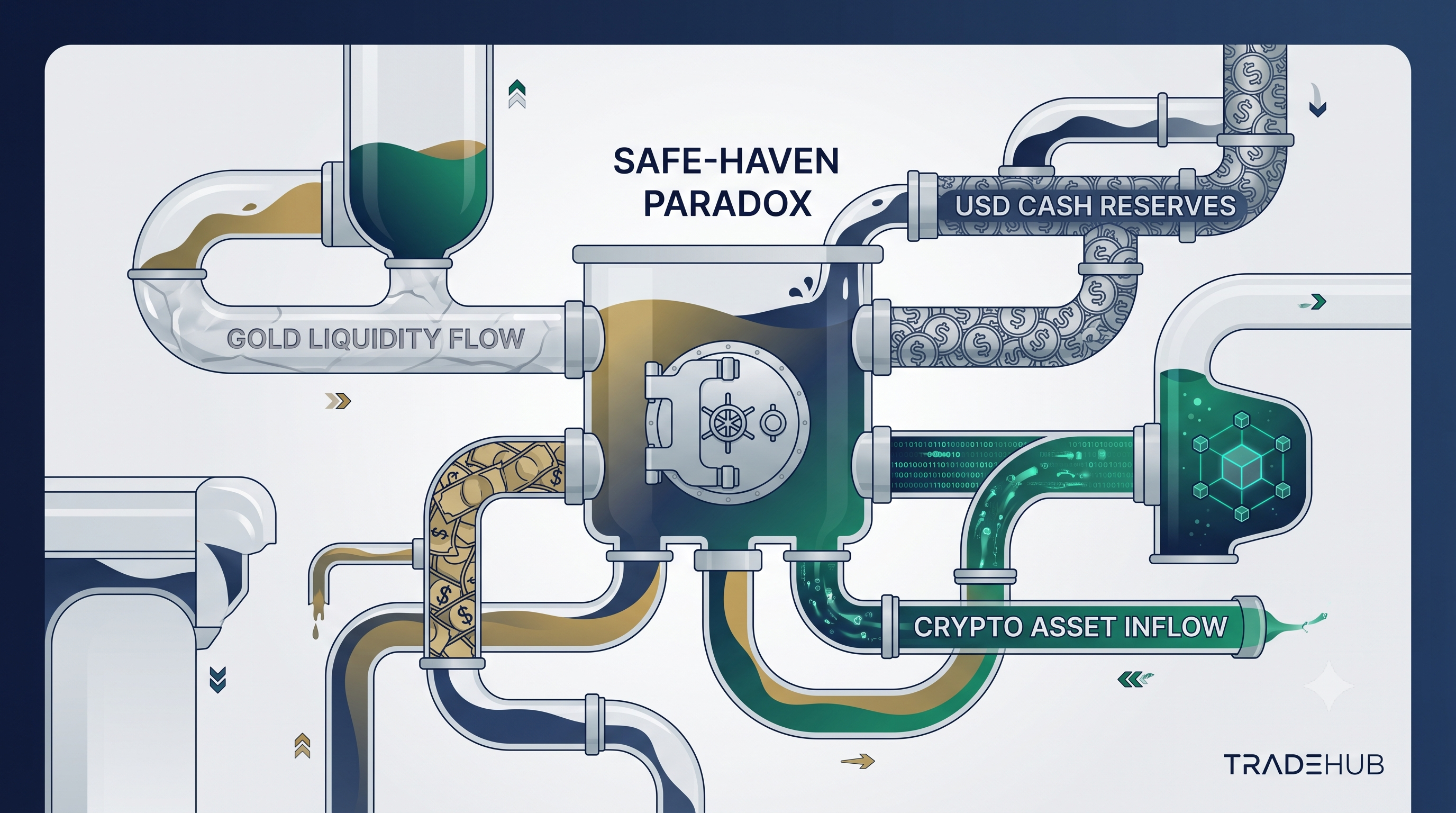
The 'Liquidity Dam' Analogy: Where is the Smart Money Flowing?
Imagine the global financial market as a giant, interconnected dam system. When an economic storm hits, the floodgates of the equity (stock) dam are opened to prevent portfolio collapse. This flow of water (liquidity) is torrential and requires a robust reservoir. The US Dollar dam is usually the first to fill up due to its unmatched market depth. However, when that dam nears maximum capacity—signaled by inflation or exchange rate devaluation concerns—water begins to spill over into the Gold dam and, more recently, the Crypto dam.
Smart money is never idle. They build small channels between these three dams. If a central bank suddenly pumps new liquidity into the system, the intrinsic value of cash erodes, aggressively driving capital outflows from the Dollar toward Gold and Bitcoin. Conversely, if liquidity is tightened, the flow reverses, squeezing alternative assets back into the Dollar.
Historical Decorrelation and the Emergence of Monetary Hybrids
Today's landscape dictates that traders can no longer rely on static correlations. We are in an era of 'monetary hybrids' where an asset's function can change overnight. Capital movement analysis shows that Bitcoin's correlation with equity markets (like the S&P 500) can suddenly break, and instead begin moving in tandem with Gold when the inflation hedge narrative dominates.
The ability to read these narrative shifts—from risk-on to inflation hedging, to liquidity crises—is the dividing line between speculators and true fundamental analysts. A resilient portfolio is no longer built by piling assets into a single correlation basket, but by understanding how these hybrid assets react independently to external shocks.
Key Takeaways
- The traditional negative correlation between the US Dollar (DXY) and Gold is not absolute during global market panics; both can strengthen simultaneously as safe-haven assets.
- Institutional liquidity moves to seek instant security through the Dollar, while Gold is utilized as a fortress for long-term purchasing power.
- Major crypto assets are beginning to exhibit hybrid properties, acting interchangeably between high-risk assets and asymmetrical hedging alternatives.
- Modern portfolio dynamics must account for smart money movements across asset classes to prevent systemic risk exposure.
Frequently Asked Questions on Hybrid Asset Diversification
What causes traditional asset correlations to frequently shift during high volatility?
These shifts are caused by a change in market participants' focus from yield-seeking to capital preservation. During a panic, institutional algorithmic movements create impulsive demand for cash liquidity (US Dollar), while simultaneously, fears of long-term inflation drive concurrent Gold purchases.
Can Bitcoin truly be considered a safe-haven asset?
Bitcoin's status remains dynamic. While it has utility as a hedge outside the traditional banking system under certain conditions, its inherent volatility still limits its function as an absolute safe haven. Bitcoin is more accurately viewed as an asymmetrical option or a hybrid digital gold.
What is the best way to read smart money flows today?
Closely monitor government bond (Treasury) yields, central bank foreign exchange reserves, and ETF fund flows in Gold and Crypto. These fundamental macro data points provide a clear trail of where institutions are shifting their risk burden.
Calibrating Portfolios Amidst Global Uncertainty
Volatility is not an anomaly to be feared, but rather the main stage for those who have prepared themselves with a solid fundamental understanding. When global liquidity flows shift unpredictably between asset classes, accurate information and interpretation are the best weapons a market participant can possess. Success in navigating the movements of the Dollar, Gold, and modern digital assets depends entirely on the sharpness of unbiased macro analysis.
For professionals who refuse to merely react to prices and prefer to anticipate market sentiment, having a peer-level discussion circle is an absolute necessity. The best strategies are born from high-quality insight exchange and real-time data updates. Staying one step ahead of institutional flows requires dedication, discipline, and the right financial intelligence ecosystem.
Navigate the Markets with a Professional Community
Join TradeHub.now and get exclusive fundamental analysis delivered straight to your device.